At Ultralight, we believe our gear is only as good as the underwater photographer, cinematographer, or camera assistant it supports and no one showcases that better than our Brand Ambassadors. To give you a closer look at their images, stories, and the passion behind their work, we asked each Ambassador a series of thoughtful questions about their backgrounds, favorite rigs, and what inspires their photography and filmmaking. It’s our way of sharing not just how Ultralight gear is used, but also the creativity and spirit of the people who bring it to life.
Please share a little about yourself and the journey that brought you to where you are today.
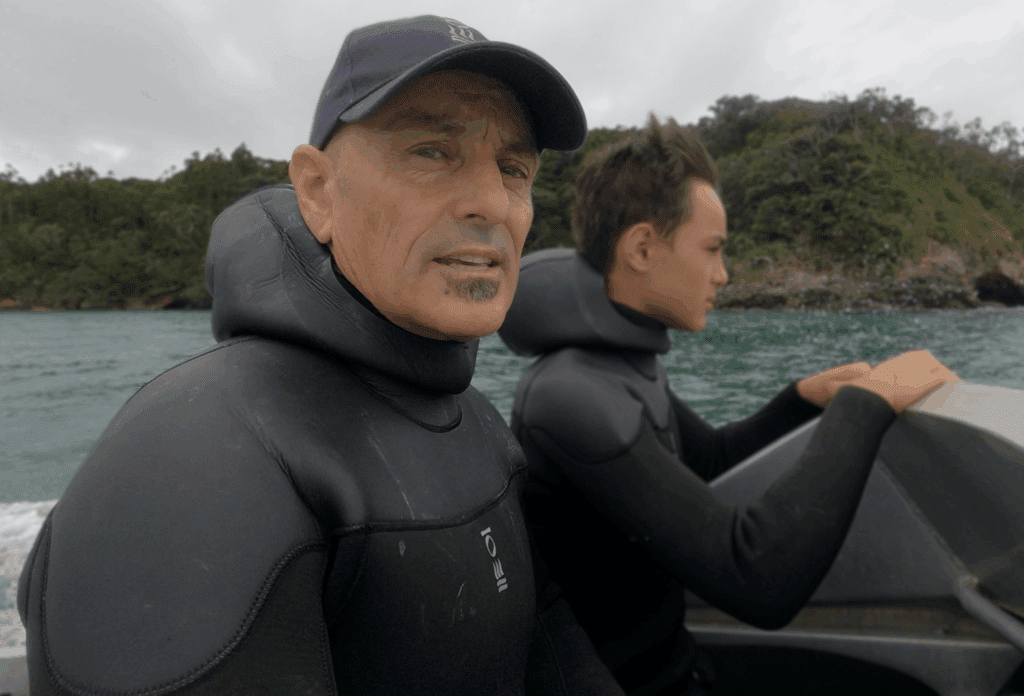
Hi, My name is Dave Abbott and I’m based in New Zealand but work all over the world as a documentary cameraman -mostly underwater, and more often than not filming sharks. I grew up by the sea and my dad was one of the pioneer divers who were making their own dive gear back in the 50’s, so I was in the water from a very early age and always knew I would pursue a career that kept me underwater as much as possible!
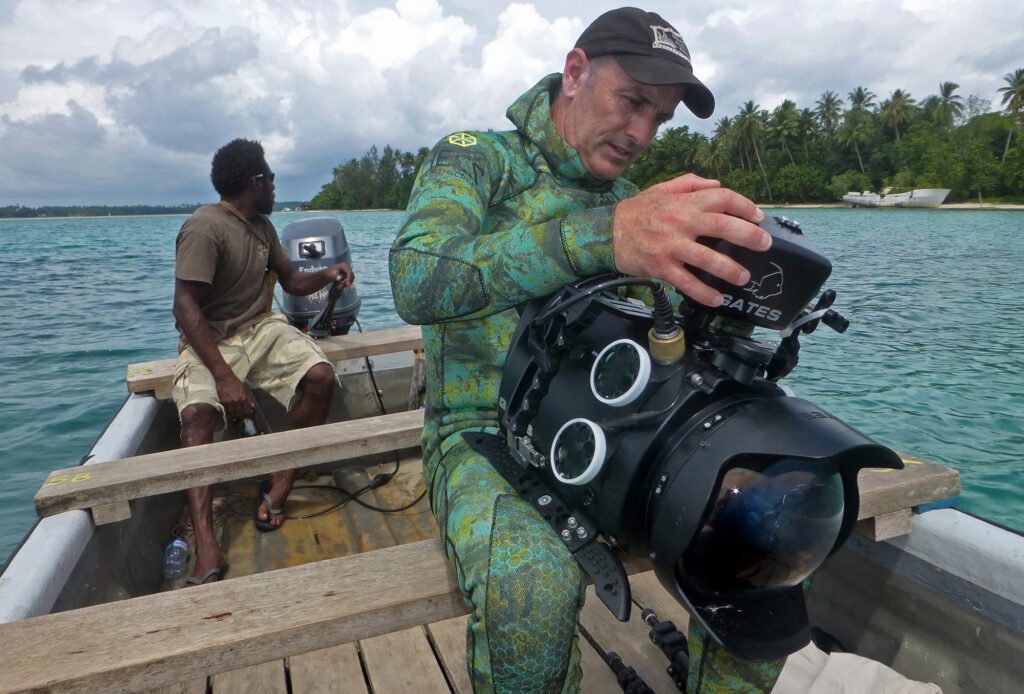
After a stint traveling around the world I did a marine biology degree. and also dive instructors and skippers tickets, then worked for a time as a dive instructor/guide/skipper, before running a small live-aboard dive boat in northern New Zealand for a few years. At the same time I was constantly developing my underwater filming skill as well as doing some scientific diving in the off-season. Underwater filmmaking was definitely my primary passion though, and I pursued a career in underwater cinematography that has resulted in me spending the last 25 years shooting for natural history documentaries and projects for the like of PBS, NHK, NHNZ, National Geographic, Discovery and Shark Week..
How did you get into underwater cinematography? What sparked your passion?
Inspiration for diving and a love for the sea came from my Dad, and my obsession for underwater filmmaking came firstly from many hours watching Jacques Cousteau and David Attenborough doco’s as a kid, then later -as an adult, wanting to share the endless diversity of life I was getting to experience through diving, and help convince other people to value and protect our marine environments.
What were some of the biggest challenges you faced when starting out?
The biggest challenge for me when I started out is actually the same one I still face now, - that of being based in New Zealand, on the other side of the world from all the big broadcasters and commissioners, which makes it more difficult to pick up regular documentary work. Keeping up with broadcast camera requirements (and the cost that involves) is another ongoing challenge!
Can you share a memorable moment or experience underwater?
I’ve had so many memorable moments over a lifetime of diving that it is impossible to single out just one! A few top moments that come to mind though are having a curious Humpback whale calf in Tahiti swim right up to me and look me in the eye while mum hung watchfully close below;- filming Giant cuttlefish males displaying to each otherin South Australia and seeing incredible patterns and colours pulsing across their bodies;- a hectic night dive with a hundred hunting reef sharks in Fakarava;- being in the middle of vast schools of baitfish while feeding Kingfish smash through them in New Zealand, — being the first to film a rare species of Nautilus in the Solomon Islands, and having had the regular privilege of diving with multiple huge Great Whites in a one-man bottom cage on Shark Week shoots - letting me look into the eyes of this apex predator from less than a metre away..
What are your favorite locations or dive sites for underwater cinematography, and why?
I have been lucky to dive in some amazing places, tropical and temperate, but probably my favourite diving spot is on my own doorstep in NZ, at an offshore island marine reserve with prolific life, and incredible underwater terrain. From sea caves, archways to lush seaweed forests, they lie in the path of an offshore current which brings tropical visitors like manta rays, marlin and argonauts in the summer, and vast schools of fish year-around, …its a place where you never know what might turn up!
What camera setup do you currently use for underwater cinematography?
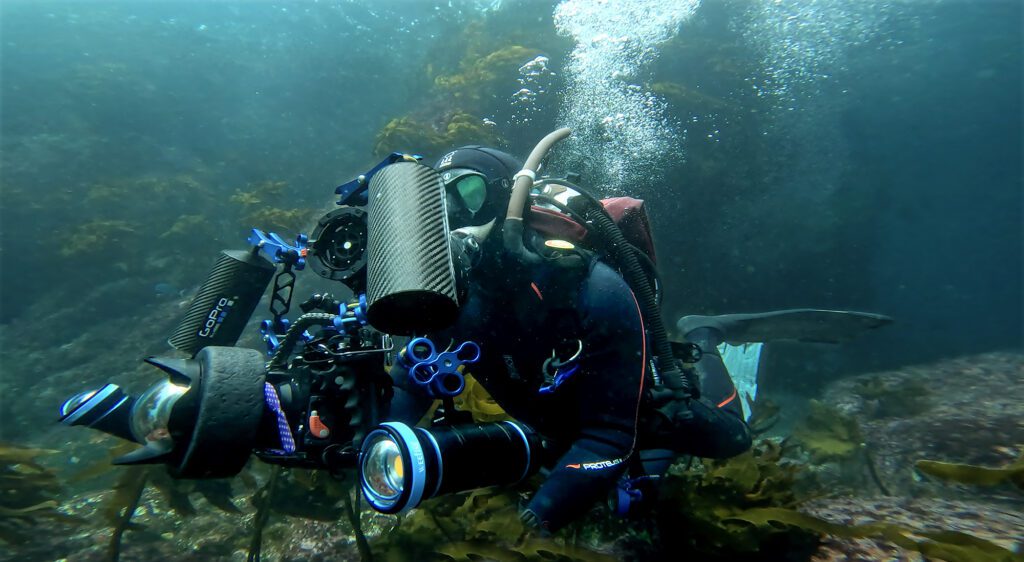
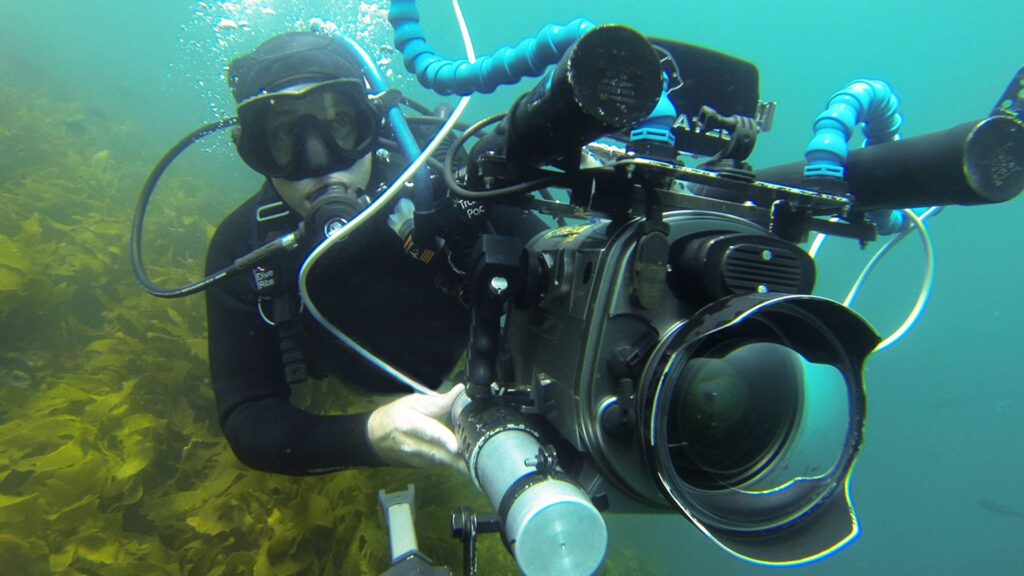
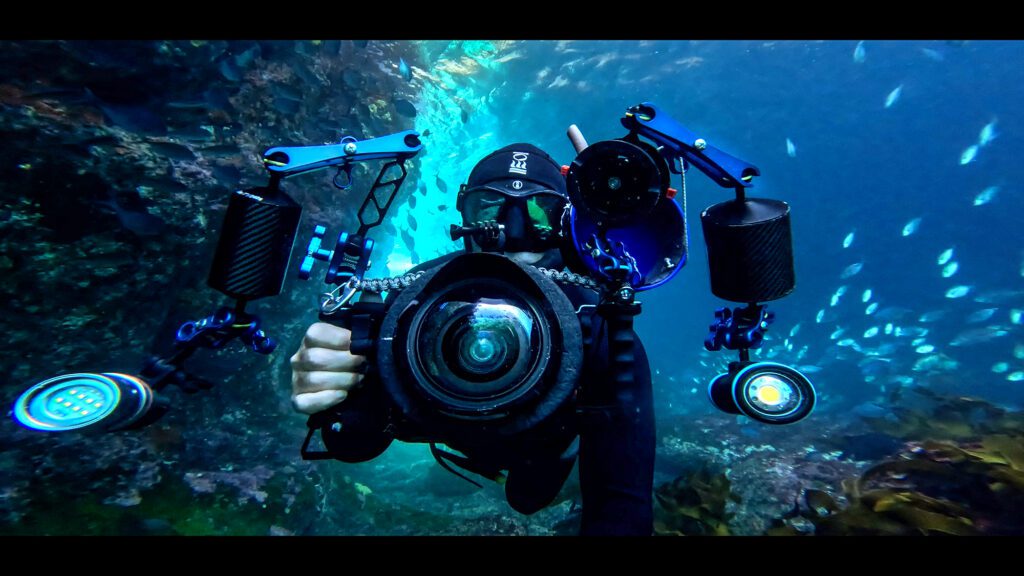
Gear-wise I am currently use a Panasonic GH6 paired with an Atomos Ninja V+ to shoot Prores 422 RAW, both in Nautical housings. For lighting I have Weefine 12K video lights mounted with Ultralight arms and clamps. Where possible I like to use a mix of natural light supplemented with artificial lights to fill and subtlety enhance the subject I am shooting.
How do you stay updated on the latest techniques and technologies in underwater cinematography? Staying updated on the latest cameras and equipment is fairly easy these days, with every new development immediately available to read about online, which is a double-edged sword! There’s always a ‘newer and better’ camera coming out, or a revolutionary lens and port combination to lust after! On a professional level that becomes frustrating because the cost of upgrading a whole system can be insane - especially when high-end broadcasters all want the latest 8K RED cameras!
My take on it nowadays is that just about any of the newer cameras are capable of achieving incredible quality, and a well lit and composed sequence from a less expensive camera is still better than a poorly framed and exposed shot from an expensive camera! I get more pleasure from talking to other camera people and divers about marine life, locations and techniques than I do talking about camera specs!
What’s your favorite piece of gear from Ultralight and why?
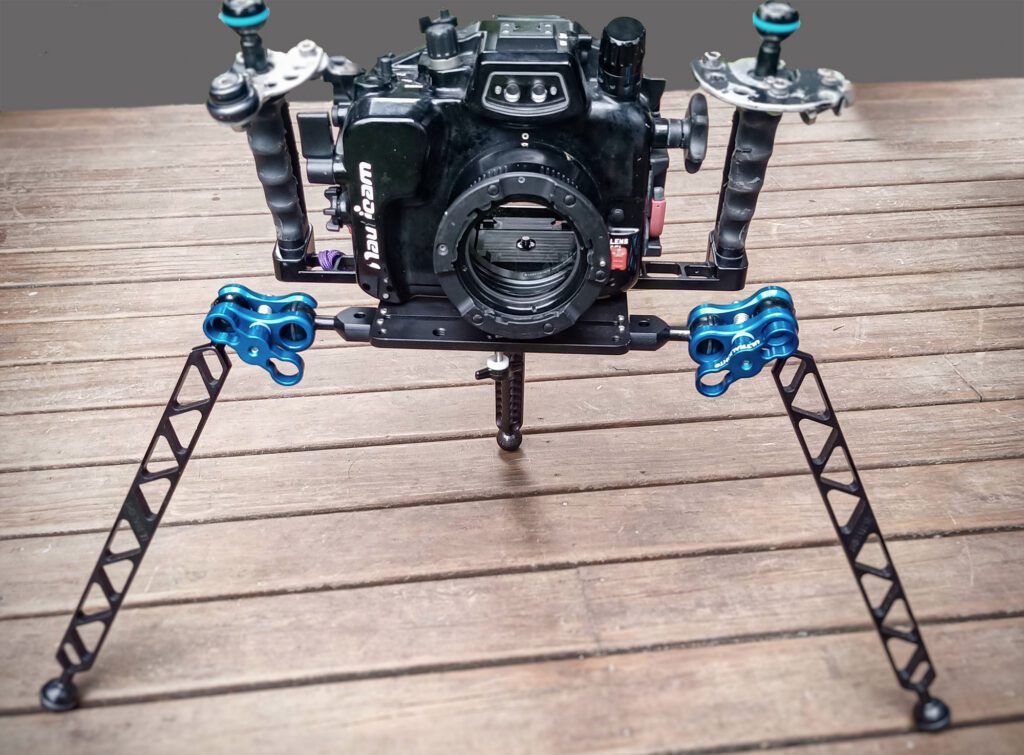
My favourite piece of gear from Ultralight are my blue anodised clamps,- apart from looking cool they lock solidly with just a small amount of pressure unlike lower quality clamps. I also love my Tri-tray tripod rig, - it is so easy to swim around with and quick to setup!
What inspires your underwater cinematography?
Like most underwater cinematographers I am passionate about the underwater world and endlessly fascinated by the diversity of underwater life, so naturally I want to share that, and inspire others to be as interested as I am, to help ensure our ocean environment and biodiversity is kept healthy in the longterm.
As far as having a favorite type of marine subject to film I’m fascinated by all marine life, so its impossible to pick one favourite! I do like cephalopods though (octopus, squid, cuttlefish and nautilus) for their intelligence curiosity and alien-like characteristics, and sharks of course, particularly Great Whites, ..being right amongst them in a solo bottom-cage is like being transported back to a jurassic world where you feel like an insignificant prey item!
Have you ever encountered any unexpected or dangerous situations while underwater?
Yes but very few considering the thousands of dives Ive done and the type of creatures I’m often filming! Having a high pressure air hose blow while in a one-man bottom cage with a wide open door was one, - being effectively blinded by an instant white-out of high pressure bubbles knowing that there are 5 large and curious white sharks circling you, and going calmly through the process of turning your air off, switching from main tank to pony bottle and from full-face comm’s mask to a regular dive mask all by feel! Being alone and backed up against a wall by 30 curious Bronze whaler sharks with the boat at another dive site was another situation that could have gone wrong, ..getting a fin trapped under a log in a murky river while filming in Tasmania gave me a few anxious minutes, and having a Blue ringed octopus float over my camera and across my bare hand in South Australia also raised my heart rate! To be honest though the situations that have scared me more have been down-currents on deep walls.
What challenges do you face as an underwater cinematography, and how do you overcome them?
Having a particular behavioural sequence to capture within a limited timeframe is always a challenge -having to work around weather windows, sea conditions, visibility and the unpredictability of wild animals! Good research and local knowledge is a big help in those situations, as well as a bit of luck!
Traveling to remote locations with fragile camera equipment and bulky dive gear can be challenging at times - but also part of the fun of location shoots - that can go either way!
Do you use your cinematography to promote ocean conservation? If so, how? As well as shooting for natural history documentaries I have done quite a lot of advocacy film projects for different NGO’s over the years, - telling stories that educate people on the benefits of marine reserves, the purpose and outcomes of scientific research expeditions and conservation initiatives, and the importance of biodiversity.
I also try to tell stories through my own projects and footage that I hope will inspire people to care more proactively about the marine environment.
How do you think underwater cinematography can contribute to marine conservation efforts?
I do think underwater cinematography can help conservation efforts through educating and inspiring people to appreciate the marine environment, but at the same time I don’t believe just taking pretty pictures is not enough, there needs to be a meaningful story, and some action to take as a result of that story.
The internet is saturated with beautiful images ‘raising awareness’ for issues that have been already been covered by the media for decades, especially of charismatic megafauna that we all like to dive with and photograph, -whales, sharks, manta’s etc, but there are a lot less images and stories shared online of lesser known, less photogenic but more pervasive issues,…the loss of kelp forest, reef sedimentation, overfishing, coastal pollution, the influx of invasive species - topics that are not as personally rewarding to document. To actually drive any real change I think images and cinematography have got to be paired with an informative story and some clear actions that people can take themselves to make a positive difference.
What’s the best piece of advice you’d give to someone just starting out? To someone starting out I would say don’t obsess about too much about the technical specs of cameras - instead focus on developing your diving skills so that that side of it second nature, and on getting really good at approaching marine life calmly without disturbance so you have plenty of time to compose your shots. Get to know your camera’s functions and settings really well on land first, and learn about the creatures you want to photograph and their habits.
Also, keep a day job to fund your new addiction!
What does being an Ultralight brand ambassador mean to you?
To me it’s a privilege to represent a quality brand like Ultralight that is highly respected in the diving world, and having their support just confirms that Ultralight are a brand who value the ocean environment and show that by getting behind filmmakers and photographers sharing the underwater world with others.
What excites you most about being a brand ambassador for Ultralight?
I’ve always been interested in design and fabrication - making or modifying gear to achieve specific filming goals, so one of the things I really like about working with Ultralight is that Ken is always open to new ideas, and if it has merit will design and fabricate a new piece of equipment fit for purpose. Functionality and reliability are also important to me - the ocean is a tough environment and hard on gear, so knowing that Ultralight is built to last is a big plus.
Has working with Ultralight influenced your workflow and creative process? Yes, - one way working with Ultralight has opened up new creative opportunities for me underwater is through the addition of a solid and practical lightweight tripod that I can have mounted on my camera rig and still comfortably swim with. This has opened up new avenues for filming that were previously difficult and cumbersome.
What’s next for you in your cinematography journey? Any exciting projects or goals?
I always have filming goals and a long bucket list! There are several Arctic species I would really like to film, -Greenland sharks, Walrus and Narwhals especially! Bluewater bait balls and that whole food chain, various freshwater oddities, and Humboldt squid are also on my list. My big goal (or dream?) is to get funded or commissioned to make a series concept that I have been working on for a few years now, - failing that, setting up a Youtube channel!:)
Thank you, Dave, for taking the time to share more about yourself and your work with us. We definitely picked up a few new things, and I’m sure our customers did too. It’s always great hearing how someone finds their way into a field they love—the wins, the lessons, and everything in between.”
For more information about Dave, you can find him at his website, Liquid Action Films, and Instagram.